














Search
Alternative Energy Transportation
Ingrid Naiman

While economists and financiers push their pencils around trying to predict how much fuel will be needed to meet transportation needs in 2030, environmentalists are fretting over 2003.
Without change, serious change, we are looking at fuel demands that are 2.5 times the present levels by 2030 and air that is many times blacker than today. Alternative automobiles or alternative transportation are the only solution to an otherwise impossible situation, one that compromises the ecological balance of our Planet, international relations, health, and survival itself.
When I was in high school (in the late 50s), an electric car was demonstrated inside the auditorium. I personally was certain we'd all be driving these cars in another few years. More than forty years later, we have the technology to achieve 100 mpg in a gasoline powered car, but few people are driving these cars. We could also use electric or hybrid fuel cars or solar powered cars (at least in some climatic zones), but we are still using fossil fuels. Is it any wonder that children who have breathed the vapor of decayed animals and algae are more fascinated by dinosaurs than butterflies?
Short-term, it's important to see what is on the market. The most fuel efficient cars are produced by Honda and Toyota, followed by Volkswagen.
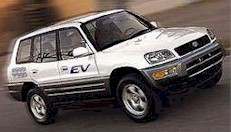
What sorts of choices are there? Alternative fuel engines are new. The hybrids use a mixture of gas and electricity (Honda Civic); then, there are cars using electricity (RAV4), fuel cells, natural gas, and ethanol. Not sure yet these are for you? No problem, the next time you rent a car, ask for a Toyota Prius or RAV4 from EV Rental, the first environmental rental car company (offices in all the major cities in California as well as Phoenix, Pittsburgh, and Washington, D.C.)
 The
Honda Insight gets over 60 mpg in the city, at least 3-4 times
better mileage than an SUV. Experts have compared the costs of
operating these cars. Based on 15,000 miles per year (a lot more
than I drive), a 4WD Jeep Cherokee runs up a gas bill of around
$1300 a year; but you don't need gas at all: the new Toyota RAV4
doesn't use gas and would cost about a thousand less to drive
than a Jeep, and it's a very nice car!
The
Honda Insight gets over 60 mpg in the city, at least 3-4 times
better mileage than an SUV. Experts have compared the costs of
operating these cars. Based on 15,000 miles per year (a lot more
than I drive), a 4WD Jeep Cherokee runs up a gas bill of around
$1300 a year; but you don't need gas at all: the new Toyota RAV4
doesn't use gas and would cost about a thousand less to drive
than a Jeep, and it's a very nice car!
Fascinated, I read some reviews on this car (since I drive an older RAV4). One review stated that driving this car is a disappointment because you are expected to make sacrifices for the environment, and this car doesn't require you to give up comfort or convenience. The other complaint is that the car is so quiet that you have to look at the control panels to figure out whether or not the engine is running. Gosh, I wonder what the stereo system is like? It would take a little while to get used to the idea that one could hear a symphony over the din of the motor.
Another unique trait of electric cars is that they recover the energy normally lost when you brake. Let me see if I can explain this. Let's say a car is moving 60 mph. It has used energy to attain that speed, but when you brake, you don't recover the energy; it's permanently lost, but with an electric car, you can increase the range by up to 25% by braking and recycling the energy back into the battery. Cool!
The problem is these cars are only available in California.
Want my advice? Install free electric battery recharging in parking stalls in all major places of employment. Why free? Well, it's totally scandalous that those who buy gas guzzling SUVs can get upwards of $30,000 in tax benefits, thanks to another of those loopholes legislators gave to their patrons. Reasonable environmental policy should be to give the breaks to those who take responsibility for the environment and where more than California is air pollution more troublesome? In fact, there is a tax rebate on the RAV4 EV, $4000 right off the total of taxes due the oil grubbing Federal Government.
There is almost no maintenance for the car: no gas, no oil changes, no spark plugs to replace, nothing to tune up, and no clutch that suffers wear and tear. You will never have to go into a gas station ever again. With a slew of rebates, the car comes in just under $30,000 or $350 per month depending on the payment plan.
Is it for everyone? No, but it's a really reasonable choice for Californians who commute. If you drive an electric car, you are permitted to use the commuter lane, just another incentive for those who are tired of intolerable traffic and road rage.


From a Reader: Hybrid Cars || Fuel Economy

Poulsbo, Washington
Copyright by Ingrid Naiman 2002, 2006, 2009, 2014
