














Search
Loss of Innocence
by Ingrid Naiman
| In the summer of 1962, I was living in Karuizawa, a mountain resort in Japan famous because it is where the now Empress Michiko met the man who was to become emperor of Japan. They met while ice skating to the tunes of a haunting guitar melody by a composer known to those of us who remember him for his exquisite romance as Mr. Anonymous. I suspect that I have for several incarnations been intrigued by the themes of unrequited love in Japanese lore; however, my fate was not to be changed by a prince but rather by an article in the Sunday Japan Times on a tribe in Africa in which the entire adult population was blind. Children were used as seeing eyes for adults and it was simply assumed that by the time one was 20, one would no longer be able to see. |
|
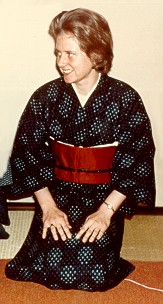
I was myself nearing my 20th birthday, and I flew into a rage. I debated how best to solve this problem. I could become a doctor and treat those who were blind, perhaps before they lost their vision. I could become a teacher and help people to understand their health and hygiene better. I could become an economist and set the wheels of progress in motion; in this case, people would have both teachers and doctors. I decided to become an economist and wrote to Yale University explaining my reason for wanting to study there. Miraculously, I was accepted, and omitting a lot of details, wound up the only female student in any of my classes and the only one who had not majored in economics as an undergraduate. I had no idea what an X and Y axis were and only the vaguest ideas about inflation and investment and the multiplier effect and so forth.
The first weeks at Yale were pure hell and after the six week exams, I was summoned into the office of the head of the department, a hugely famous economist with an intimidating demeanor. He said he wanted to talk to me, and I actually had no doubt that this was the case because I suspected I was failing royally. To the contrary, I had come in second and he wished an explanation of how someone who had attended a fifth rate university as an undergraduate and not majored in economics had managed so well. I thought he was pulling my leg since I truly felt I knew nothing at all. However, he was serious so I said, "Well, everyone else is here because they already know everything and they are busy proving this hour after hour. My mind is open because it's all new and I don't have any of the preconceived ideas that others seem to have." This remark obviously made him very uncomfortable, but he muttered, "interesting."
Being the sole woman in my classes made me terribly conspicuous and uncomfortable, but I quickly became the pet of a few professors and even some classmates who wanted to help me learn about economic models and other abstractions that I found wholly irrelevant to the real world. The more variables there were, the more mathematically complicated all became, and then for reasons of the variables, only one model would work, but it would just be a monstrous effort to connect minutia in a way that would impress other people bent on more sophisticated ways of interpreting the past.

My professors advised me to sign up for as many job interviews as possible because practice in answering questions would result in my finding a better job. I tried to take their advice but recruiters coming to Yale were expecting to meet very well connected young men who would increase their business. No companies were subject to the laws that had not yet been written about job discrimination. Most companies had their token African-American employees but no women. I protested that I wanted to be interviewed and the recruiters would reach for their coffee cups because they clearly had a break from the challenge of interviewing cocky Yalees.
As many have pointed out, getting a sheepskin from Yale was a very good career move, but attending classes had not been good for my right brain and I was looking forward to something real, like a job in a third world country. No one would think of it. They were not going to send a woman overseas. I didn't get any further than New York City.
While an undergraduate, I noticed that foreign students at the East-West Center (University of Hawaii) decried American political apathy. We had had reason to be more involved: fallout from nuclear testing in the Pacific was reaching our Island Paradise, but we choked without showing we cared. Months after entering Yale, Pres. Kennedy was assassinated; and shortly after starting work on Wall Street, Lyndon Johnson announced the Gulf of Tonkin incident, which we now know never happened.
As I said in another essay, Americans did not know they were at war much less what the ramifications of this were. I was young, awfully young. I was on the training program of an investment bank which only served millionaires. I was fresh out of grad school and earning the colossal salary of $7000 a year. On this, I paid roughly 14% in taxes, but there was absolutely no one whose investments our bank managed that was in more than a 2% tax bracket. Many, such as the wealthiest woman in the world, were in zero percent tax brackets.
I was now free of academia and its models. In the real world, this is how it works: if you are rich and lobby for loopholes, you will not have to pay any taxes. A few weeks into the training program, I was put in somewhat more sensitive places. I now got to help settle an estate that was being divided equally between four universities. I had to do all the arithmetic and make sure that each recipient got exactly the same value of stocks. This was before the days of computers and electronic calculators. I did it all on miles of tape.
I spent a month in this department of the company and realized that settling an estate is a very tedious business. Then, one day, someone asked me to deliver a check to a law office across the street. I said, "Why?" It seems the deceased had named a lawyer as executor so he was entitled to a check for $230,000 and change even though he had not so much as picked up the phone while the hundred or so attorneys in our bank were settling the estate. Nevertheless, fiduciary roles are very clearly defined by law and a name on a will might be worth hundreds of thousands of dollars to the attorney who promises to look after everything for you after you are gone.
My next big rotation was into the research department where I would work for the next two and half years. We were organized into groups; and, being that lone woman, I was assigned the food and beverage industries and retail trade, but I was working under the chemical analyst who was also in charge of the pharmaceutical industry. He took a month's vacation during Vatican II and said, "Cover me." In retrospect, I don't think jobs were regarded as particularly difficult to learn or they wouldn't have put me in a situation where I had to make investment recommendations on Monsanto and Eli Lilly stock.
So, I suddenly had two jobs: my own and that of my boss whose phone never seemed to stop ringing . . . and for very good reasons.
People wanted to know which stock to buy if the Pope approved birth control. I feel my innocence was lost that summer. Having majored in Asian Studies as an undergraduate, I had taken lots of courses in religion and philosophy; and I really thought that birth control was a religious issue, not an investment one. I spent long hours in the company library reading the files of every company that produced a birth control contraption or pill. I couldn't stay focused on balance sheets; I wanted to know about the options, marketing, and third world promotion of these products since the companies all saw global population control as the future for their expansion.
The pill, as I was soon to discover, is a very dangerous bullet, almost a sure ticket to trouble. I read stacks and stacks of files on the law suits against the major pharmaceutical companies, and, I had my first experience hearing a whistle blow. A secretary called saying she just had to talk to someone. I asked, "Why me?" She was emotional, shaken. She said that the monkeys in the experiment had all died. I wanted to know why the drug was going to be marketed when it wasn't safe. She said, "Oh, management comes in here and puts pressure on research to beat the competition to the market." The drug had FDA approval and would be given to millions of unsuspecting people and I was privy to secondhand tales that had me shaking in my high heels.
I read on. These were the Thalidomide days. The files were full of horrible pictures of severely deformed babies and the law suits made me believe that all pharmaceuticals were bad investments because I could not imagine that companies that face such serious allegations would survive the scandals. Wrong again. The worst offenders were great investments and our company had purchase policies for our millionaire customers, not to mention what employees were doing on the side.
There is more I want to tell about Wall Street, but not today. I want to jump straight to Vietnam . . . where I ended up working on fiscal reform: taxes!


Essays on Vietnam || Reminiscences of Vietnam
More on Thalidomide and its comeback as a new wonder drug:

Poulsbo, Washington
Copyright by Ingrid Naiman 2002, 2006, 2009, 2014
